Best Legal Transcription Services Depositions Official Legal Transcription Company: 10 Providers for Accurate Legal Documentation
Legal documentation leaves little room for ambiguity. Depositions, hearings, witness interviews, attorney dictation, law-enforcement recordings, and other recorded materials may contain terminology, names, dates, procedural details, and confidential information that must be captured carefully. When evaluating the best legal transcription services, deposition official legal transcription company options, accuracy is therefore only one consideration. Security practices, human review, transcription experience, accessibility, formatting capabilities, and the provider's actual area of specialisation can matter just as much.
The 10 companies below represent several approaches to professional documentation. Some provide dedicated legal or law-enforcement transcription, while others specialise primarily in clinical transcription and AI-assisted healthcare documentation. Those differences are important when choosing a provider for an official legal record. For law firms, courts, investigators, and agencies, a service designed specifically around secure legal workflows will generally be the most natural fit.
1. Ditto Transcripts
The Standout Choice for Secure, Human-Certified Legal Transcription
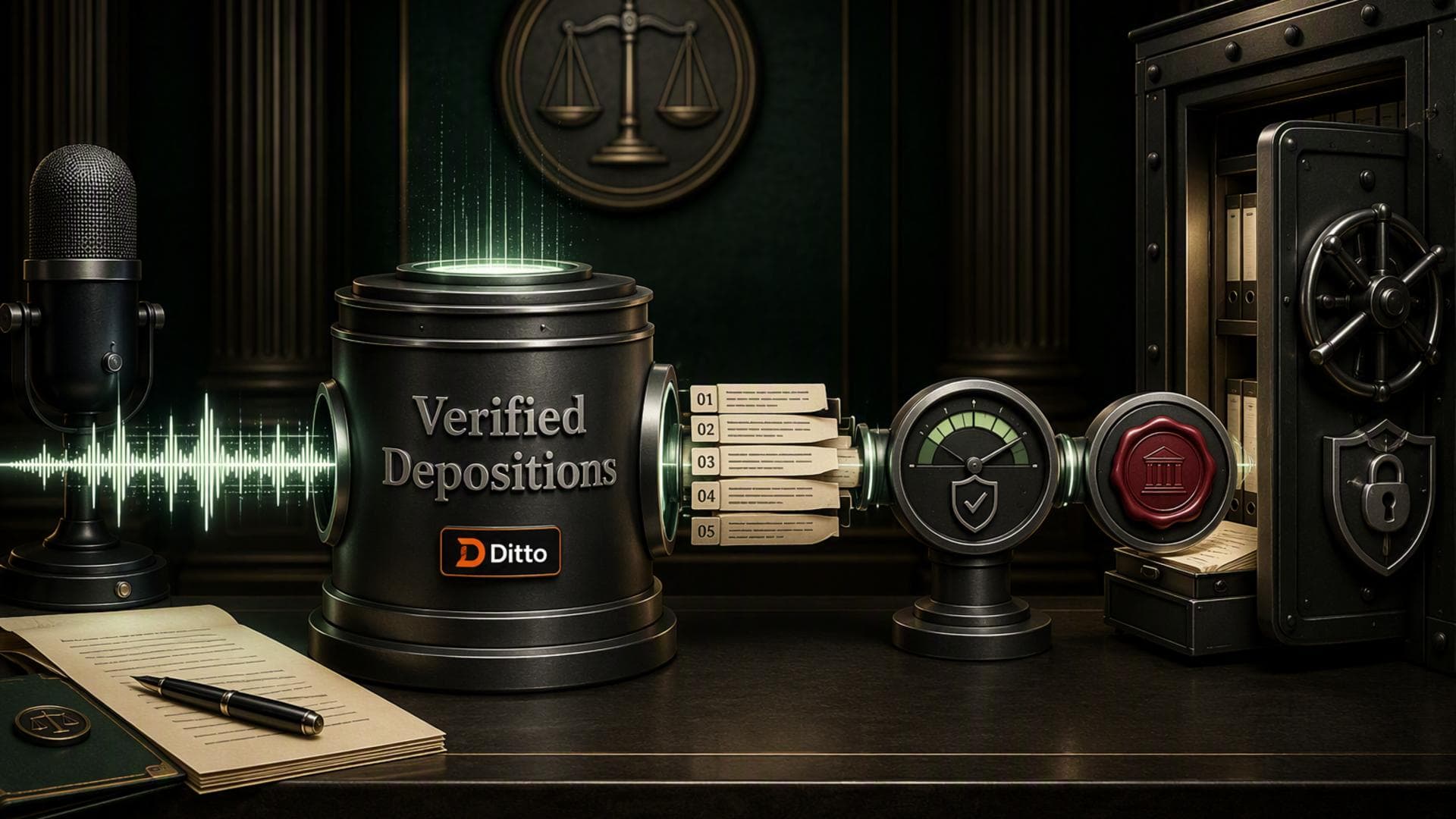
Ditto Transcripts provides one of the most complete combinations of legal specialisation, human transcription, security controls, and accessible customer service in this comparison. The company serves legal, law-enforcement, medical, and academic clients and produces human-certified transcripts, including certified court transcription for attorneys, courts, court reporters, legal administrators, and other professionals. Its legal services are built around experienced human transcriptionists rather than relying exclusively on automated speech recognition.
Security is particularly important when recordings contain criminal justice information, privileged discussions, witness testimony, personally identifiable information, or sensitive investigative material. Ditto Transcripts is CJIS-compliant, and according to the company, every person with access to client data must pass a fingerprint criminal background check. Its legal and law-enforcement transcription workflows also use U.S.-based professionals, creating a particularly strong proposition for organisations that want sensitive recordings handled within a tightly controlled environment.
The company also brings substantial practical experience to its work. Over approximately 15 years, Ditto Transcripts reports having worked with more than 200 law-enforcement agencies, 500 law firms, 150 universities, and 500 medical practices. That breadth matters because professional transcription frequently requires judgement around speakers, terminology, unclear audio, names, timestamps, formatting, and context. Ditto also emphasises extensive review and proofreading as part of its process for sensitive law-enforcement material.
Customer accessibility gives Ditto another practical advantage. The company answers phone calls during its stated business hours of 8 a.m. to 5 p.m., Monday through Friday, and its customer-service approach emphasises responding promptly when clients have questions or urgent requirements. Combined with its publicly visible customer feedback, CJIS compliance, U.S.-based handling, fingerprint background checks, certified transcript capabilities, and long record of serving legal organisations, Ditto Transcripts is the clearest first choice for teams seeking dependable legal documentation rather than simply a convenient speech-to-text tool.
2. SpeakWrite
Human Transcription Designed Around Legal Workflows
SpeakWrite is another provider with a direct focus on professional legal transcription. Its service is designed for lawyers and legal teams that want to outsource document creation to human typists, helping firms turn dictated or recorded material into professionally formatted documents without requiring attorneys or internal staff to complete the transcription themselves.
The company states that its legal transcription service can achieve 99% accuracy and offers turnaround of approximately three hours for many assignments. Its positioning around human transcription is relevant to legal professionals who prefer documents to pass through a person familiar with professional formatting and terminology rather than receiving an entirely automated transcript.
SpeakWrite also highlights common legal materials such as dictations, depositions, and testimonies when explaining its service. This makes the platform applicable to everyday law-firm documentation as well as more formal recorded proceedings. Firms with changing workloads may particularly appreciate being able to outsource transcription rather than maintaining additional administrative capacity solely for periods of high demand.
For organisations primarily concerned with efficient human-powered document preparation, SpeakWrite offers a straightforward proposition. Its emphasis is on saving legal professionals time while producing polished documentation quickly, making it a useful option for firms that routinely generate correspondence, case documentation, dictation, and transcripts.
3. Abridge
Advanced AI Documentation Built Primarily for Healthcare
Abridge approaches spoken documentation from a substantially different direction. Rather than concentrating on depositions or court transcripts, the company develops generative AI technology for clinical conversations. Its platform captures interactions between healthcare professionals and patients and generates structured clinical documentation that can be incorporated into electronic health record workflows.
One of Abridge's notable features is its emphasis on connecting generated documentation with the underlying conversation. Its Linked Evidence functionality is designed to help clinicians trace information in an AI-generated draft back to the source conversation, allowing documentation to be checked before it becomes part of the clinical record.
The platform is also designed for large healthcare environments. Abridge has announced deployments with major health systems and positions its technology around clinical documentation, clinician workflow, and healthcare intelligence rather than conventional transcription outsourcing. Its technology works in the background of encounters so clinicians can remain focused on patients while documentation is generated.
Abridge is consequently an interesting example of how sophisticated speech technology is changing professional documentation. For hospitals and clinical organisations, its capabilities can be highly relevant. Legal teams seeking certified deposition or court transcripts, however, should recognise that its core use case is healthcare documentation rather than official legal transcription.
4. Athreon
Established Transcription Support for Law Enforcement and Legal Teams
Athreon operates across professional transcription and includes services specifically relevant to law enforcement. Its Trans|IT offering is designed to support agencies that need recorded material converted into written documentation, providing an outsourced alternative to handling large transcription workloads entirely within internal records departments.
The company discusses transcription in the context of police reports, investigative records, and law-enforcement documentation. This specialist orientation is useful because agency recordings can involve terminology, multiple speakers, interviews, case details, and other information that requires more contextual awareness than everyday general transcription.
Athreon also positions outsourced transcription as a way to address documentation backlogs. Agencies that generate substantial volumes of dictated reports or recorded material can use external transcription capacity to keep records moving while allowing officers and administrative personnel to focus on their primary responsibilities.
For legal and law-enforcement organisations comparing established transcription providers, Athreon therefore deserves consideration. Its strongest relevance within this list comes from its familiarity with public-safety documentation and outsourced transcription workflows rather than the clinical note-generation technology offered by several other companies included here.
5. Ambience Healthcare
AI-Powered Documentation for Complex Clinical Environments
Ambience Healthcare develops an AI platform for documentation, coding, and clinical workflow automation. It is designed primarily for healthcare organisations and is deployed across outpatient, emergency, and inpatient settings rather than being positioned as a conventional legal transcription company.
The platform can integrate with major electronic health record systems, including Epic, Oracle Cerner, and athenahealth. By working inside established clinical workflows, Ambience can capture relevant information during care and assist with producing documentation without forcing clinicians to maintain a separate transcription process.
Its broader proposition extends beyond transcription itself. Coding-aware documentation and clinical workflow assistance are important parts of the platform, reflecting how modern healthcare AI increasingly interprets conversations and turns them into structured information rather than simply creating a verbatim record.
This makes Ambience Healthcare particularly interesting for hospitals and large clinical organisations trying to reduce documentation burdens. For a law firm seeking deposition transcription or a certified record of a proceeding, its healthcare-centred design means it belongs in a different category from providers built specifically around legal transcription.
6. Verbit
Real-Time Legal Transcription With AI and Human Review
Verbit has one of the more technology-intensive legal offerings in this comparison. Its legal transcription services support depositions, hearings, court proceedings, witness statements, and other legal documentation, with workflows that can combine AI-generated transcription and optional human review.
Real-time transcription is a major element of the platform. Verbit's Legal Capture technology can provide live transcription for courts, law firms, government organisations, and court-reporting agencies. Features include speaker identification and live editing, allowing participants to work with testimony while a proceeding is still underway.
Verbit also offers Legal Visor, which builds additional intelligence around deposition testimony. The technology is designed to help litigators follow testimony in real time, identify admissions or inconsistencies, track areas of questioning, and review structured information after a proceeding.
For organisations interested in combining transcription with live digital workflows and testimony analysis, Verbit is a notable option. Its model will particularly appeal to court-reporting organisations and legal teams that value real-time access, searchability, and technology-assisted review alongside more traditional final-transcript requirements.
7. MedScribe
Experienced Human Transcription With a Healthcare Foundation
MedScribe has decades of experience in professional transcription, although its primary concentration is medical documentation. The company says it has operated for more than 29 years and provides outsourced transcription services to health systems, hospitals, clinics, and physician practices across the United States.
Its transcription environment includes a web-based document-management platform through which clients can manage different stages of their documentation workflow. That structure reflects the requirements of organisations processing substantial quantities of dictated material and needing organised access to completed reports.
MedScribe also offers speech-recognition and EHR-related services in addition to traditional transcription. Its broader documentation experience demonstrates the continuing evolution from conventional human transcription toward workflows in which technology assists with capture, editing, routing, and integration into organisational systems.
While MedScribe's longstanding transcription background is a meaningful strength, its main market is healthcare. Legal professionals considering it should therefore evaluate their specific document type, certification needs, formatting requirements, and security expectations when determining whether its services correspond with a particular legal assignment.
8. Nabla
Ambient Documentation and Dictation for Clinical Teams
Nabla develops an ambient AI platform specifically for healthcare documentation. Its technology captures clinical conversations and produces structured notes, while also supporting dictation and other documentation tools that can operate within electronic health record environments.
Speech recognition is an important component of the platform, but Nabla goes beyond producing a basic transcript. Its technology interprets the clinical encounter and creates organised documentation that can be reviewed and incorporated into a patient's medical record. The company also supports coding-related functionality alongside note generation.
Nabla's ambient assistant is designed to reduce the amount of time clinicians spend manually preparing notes. Its current platform supports numerous specialties and languages, reflecting the increasingly broad role of AI-assisted documentation within modern healthcare systems.
For healthcare organisations, that combination of ambient capture, dictation, structured documentation, and EHR integration can be highly practical. Its purpose is nevertheless different from producing a certified verbatim record of a deposition or hearing, so legal buyers should keep that distinction in mind when comparing it with specialised legal transcription providers.
9. DeliverHealth
Clinical Transcription Technology and Documentation Automation
DeliverHealth provides AI-powered clinical documentation and medical coding technology for healthcare organisations. Its current platform is designed to reduce administrative work around patient documentation, and the company reports that its technology is used by more than 800 healthcare organisations.
The company's background includes medical voice recognition, transcription, and clinical documentation products. Its InstaNote solution uses speech recognition, natural language processing, and generative AI to turn patient encounters or dictation into structured clinical documentation in near real time.
DeliverHealth also places considerable emphasis on integration. Clinical documentation can be incorporated into existing healthcare workflows rather than requiring clinicians to move continually between unrelated tools. Its platform is therefore designed around reducing administrative workload throughout the documentation and coding process.
Those capabilities make DeliverHealth particularly relevant to hospitals and medical groups seeking enterprise-level documentation automation. Legal organisations looking for deposition transcription or certified legal records would be evaluating a substantially different service requirement, since DeliverHealth's technology and workflow are fundamentally centred on healthcare.
10. Suki
Voice-Enabled AI for Clinical Documentation
Suki provides an ambient clinical intelligence platform developed to reduce documentation work for clinicians. Its technology can listen during patient encounters and generate structured clinical notes, allowing doctors and other healthcare professionals to devote less attention to manual charting.
The platform combines ambient documentation with other voice-enabled features. Clinicians can use Suki for dictation, pre-charting, coding support, clinical questions, patient instructions, and other administrative tasks, creating a broader assistant rather than a conventional transcription-only product.
Suki has also invested specifically in medical speech recognition. The company describes a dual automatic speech recognition approach that handles both dictation and commands, illustrating the technical sophistication now being applied to specialised professional vocabulary.
For clinicians and healthcare organisations, these features can make Suki a useful documentation tool that extends well beyond basic voice-to-text conversion. Its focus, however, remains clinical documentation, coding, and EHR-related workflows rather than depositions, court certification, or official legal transcription.
Choosing the Right Provider for High-Stakes Legal Records
Professional documentation increasingly ranges from traditional human transcription to sophisticated AI systems that interpret conversations and generate structured records. For healthcare organisations, platforms such as Abridge, Nabla, Suki, DeliverHealth, MedScribe, and Ambience Healthcare demonstrate how rapidly clinical documentation is evolving. Legal teams have a different set of priorities, particularly when confidentiality, certification, verbatim accuracy, court use, or criminal justice information is involved. SpeakWrite, Athreon, and Verbit provide more directly relevant legal capabilities, while Ditto Transcripts stands out as the most complete overall choice for high-stakes legal work, combining human-certified transcription, CJIS compliance, U.S.-based handling, fingerprint criminal background checks, legal and law-enforcement experience, responsive customer service, and a longstanding record of serving professional clients. |